Tag: shopify developer

  • Hiring a Shopify / e-commerce Developer vs DIY in 2027

    Hiring a Shopify / e-commerce Developer vs DIY in 2027

    Launching a Shopify store is easy. Building one that looks premium and converts is a different job. That’s where an e-commerce developer earns their fee.

    Plenty of merchants try the do-it-yourself route first. Many end up with a store that works but doesn’t impress. Shoppers notice, and they don’t always come back.

    This guide explains why hiring an e-commerce developer is worth it. You’ll see what they do beyond drag-and-drop, and what you’re really paying for. You’ll also learn how to choose the right one.

    Why hire a person when AI is free?

    AI tools are everywhere now. Many of them cost nothing. You can ask one to explain Shopify, write copy, or suggest a layout in seconds.

    But free tools only answer the questions you know to ask. They don’t know your brand. They don’t know your customers. And they can’t tell you what’s missing from your store.

    A developer brings the context AI lacks. That’s the real reason to hire one.

    Related post: Using AI to Drive Up Sales in Shopify

    Setting up a Shopify store is easy

    Anyone can launch a store in an afternoon. Pick a theme, add products, connect payments. Done.

    The platform is built for that. Shopify wants you live fast.

    The result, though, often looks like every other store. Default theme. Stock layout. Nothing that says “trust us with your credit card.”

    What a seasoned developer does beyond setup

    Setup is where an experienced developer starts, not where they finish. The real work is making your store easy to shop. They organise your products so customers find what they want quickly. They also keep pages loading fast, especially on phones.

    The buying experience gets the same attention. Product pages, the cart, and checkout are designed around how people actually shop. They also choose the right tools for email and reviews, and skip the ones that slow your store down.

    Then comes the behind-the-scenes work. They make sure your store shows up in Google and works on every device. They track your numbers too, so you can see what’s working. After launch, they keep spotting what to improve as your business grows.

    None of this shows up in a theme demo. But shoppers feel it, and so do your sales.
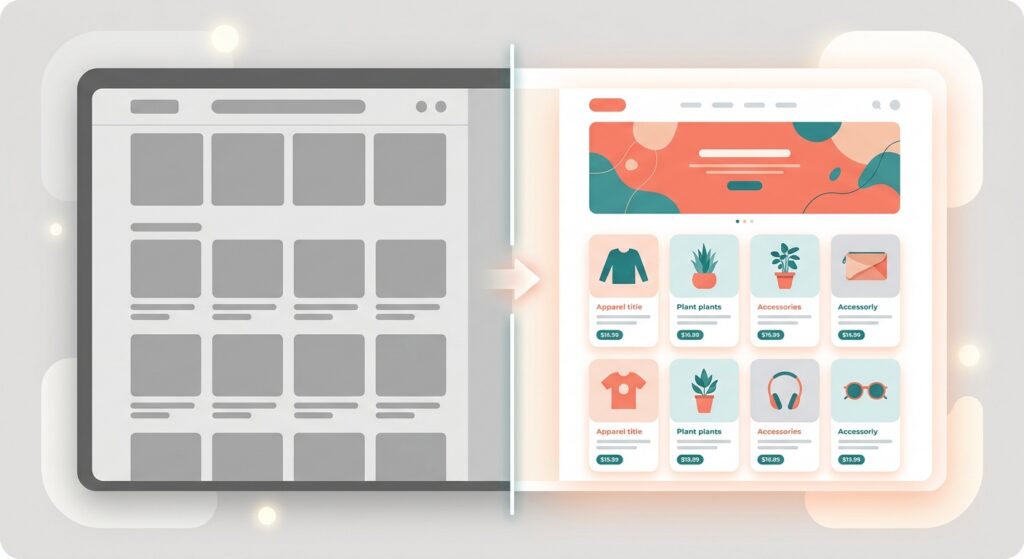
    Wireframe website transforming into a colorful online store layout

    Making it look premium is the hard part

    Premium design is about details. Spacing, typography, image quality, and consistency all matter. Shoppers can’t always explain why a store feels cheap. They just leave.

    Good design builds trust before a shopper reads a single word. It signals that your products are worth the price. That’s especially true if you sell higher-priced items.

    Storefront customisation is more than drag-and-drop

    The theme editor is friendly. You can move sections, change colours, and swap images. But it only goes so far.

    Real customisation means working beyond the sections the theme gives you. Think custom product page layouts, smarter navigation, or a checkout that matches your brand. It also means keeping the store fast while you do it.

    A drag-and-drop edit can look fine on desktop. On mobile, it might break. Someone has to test that. And someone has to know why it breaks.

    What you’re actually paying for

    Not hours of typing. AI handles a lot of that now. You’re paying for expertise and knowledge.

    That means a few things:

    • Pattern recognition from building many stores
    • Knowing which apps are worth installing, and which will slow you down
    • Spotting conversion leaks before they cost you sales
    • Making design decisions that suit your brand and customers

    An experienced developer has seen what works. They’ve also seen what fails. That experience saves you from expensive trial and error.

    Related post: The Top 5 Things You Need to Know to Be a Shopify Expert

    Two people review a website and checklist, symbolizing digital quality assurance

    Hire the right e-commerce developer

    Look for someone who asks questions first. Good developers want to understand your business before they touch your theme. Ask to see past stores. Check that they care about speed and mobile, not just looks.

    Be wary of anyone who quotes a price before asking what you sell. That’s a template job, not a tailored one.

    Also ask how they use AI. The best developers use it to move faster. They don’t use it as a substitute for thinking.

    Final thoughts: DIY-ing with AI versus hiring an experienced e-commerce developer

    Doing it yourself with AI is a fair option. It’s fast, it’s cheap, and it works well for a simple store. You can get live this week and learn a lot along the way.

    Hiring an experienced developer is a different bet. You pay more upfront. In return, you get a store that looks premium, loads fast, and is built to convert. You also skip the trial and error.

    So the choice comes down to your goals. If you’re testing an idea, start with AI. If you’re building a brand customers should trust, hire an experienced developer.

    Planning your 2027 store and want a second opinion? iconjen.com

  • Merchants Should Not Pay Shopify Experts to Code

    Merchants Should Not Pay Shopify Experts to Code

    For years, “hire a Shopify expert” meant hiring someone to write Liquid, tweak a theme, or build a custom feature. That model is dying. And honestly, it should.

    AI and coding MCPs can now write, test, and ship custom theme updates fast. Most freelancers and agencies can’t quote a project in that time. Ask for a new feature or a theme customisation, and that’s no longer a job for a human typing code. It’s a job for AI.

    So if you’re paying someone by the hour to write code, you’re paying for the wrong thing.

    Related post: The Top 5 Things You Need to Know to Be a Shopify Expert

    What actually changed

    Custom coding used to be the bottleneck. Every tweak meant finding a developer, briefing them, waiting on a quote, waiting on the build, then testing it.

    AI-assisted coding tools and MCP servers have collapsed that timeline. Implementation is now the cheap, fast part. Knowing what to build — and why it’ll actually move your numbers — is not.

    That’s the part AI can’t do for you. And it’s the part worth paying for.

    Illustration of code snippets transforming into a finished webpage on a laptop screen, with cloud and gear icons symbolizing web development

    What a Shopify expert should actually be doing

    If someone’s charging you to be a Shopify expert in 2026, here’s what to expect — not a line of code.

    1. Finding the revenue leaks you can’t see

    Every store has leaks like these:

    • A checkout step quietly killing conversion
    • Confusing category hierarchy on collection pages
    • A shipping threshold nobody’s told the customer about
    • An unused upsell opportunity

    Spotting these takes someone who’s looked at enough stores to recognise the pattern. Not someone who can write code — someone who knows where to point it.

    2. Recommending solutions that actually lift AOV

    Not “install this app” as a generic tip — a specific read on your store: catalogue, margins, customer behaviour. Should you be bundling? Is a post-purchase upsell worth more than a pre-cart one? Is your free shipping threshold set correctly, or is it too low to matter and too high to hit?

    This is judgment built on pattern-matching across real stores. It’s not a checklist.

    3. Suggesting apps that solve a real, specific problem

    The Shopify App Store has thousands of apps. Most merchants install based on a blog post or a sales pitch, not an actual diagnosis of what’s broken.

    A good expert tells you not to install half the apps you’re considering. Your actual bottleneck is usually somewhere else entirely. Then they recommend the handful that genuinely solve the problem you have — not a problem you might have.

    Why AI can’t do this part

    AI is excellent at execution once you know what you want built. But it’s not walking your store and noticing your mobile menu buries your best-selling category three taps deep. It won’t connect that to your mobile conversion numbers on its own.

    A 10% discount code quietly eating your profit on your highest-AOV segment? AI won’t flag that unless you already know to ask. And some problems aren’t code problems at all. Maybe your real issue is checkout. Maybe it’s the traffic you’re targeting. Either way, spotting it takes someone sitting across from your business — not a prompt.

    That’s strategic, store-specific judgment. You can’t prompt your way to it, because most of that context isn’t written down anywhere for AI to find.

    Illustration of a sales funnel with a crack labeled "crack/gap" where customer figures leak out before reaching a storefront, examined by a magnifying glass as a person watches

    The shift merchants need to make

    Stop paying for implementation. Pay for diagnosis.

    Briefing a “Shopify expert” for a line of code means overpaying for something AI will do cheaper. Briefing them for a clear answer is different. Where am I losing revenue? What’s actually worth fixing first? That’s the job AI still can’t do.

    Want a second pair of eyes on where your store’s actual leaks are, not a quote for custom code? That’s the conversation worth having. iconjen.com

  • Shopify Product Pages: Why Yours Aren’t Converting (And How to Fix Them)

    Shopify Product Pages: Why Yours Aren’t Converting (And How to Fix Them)

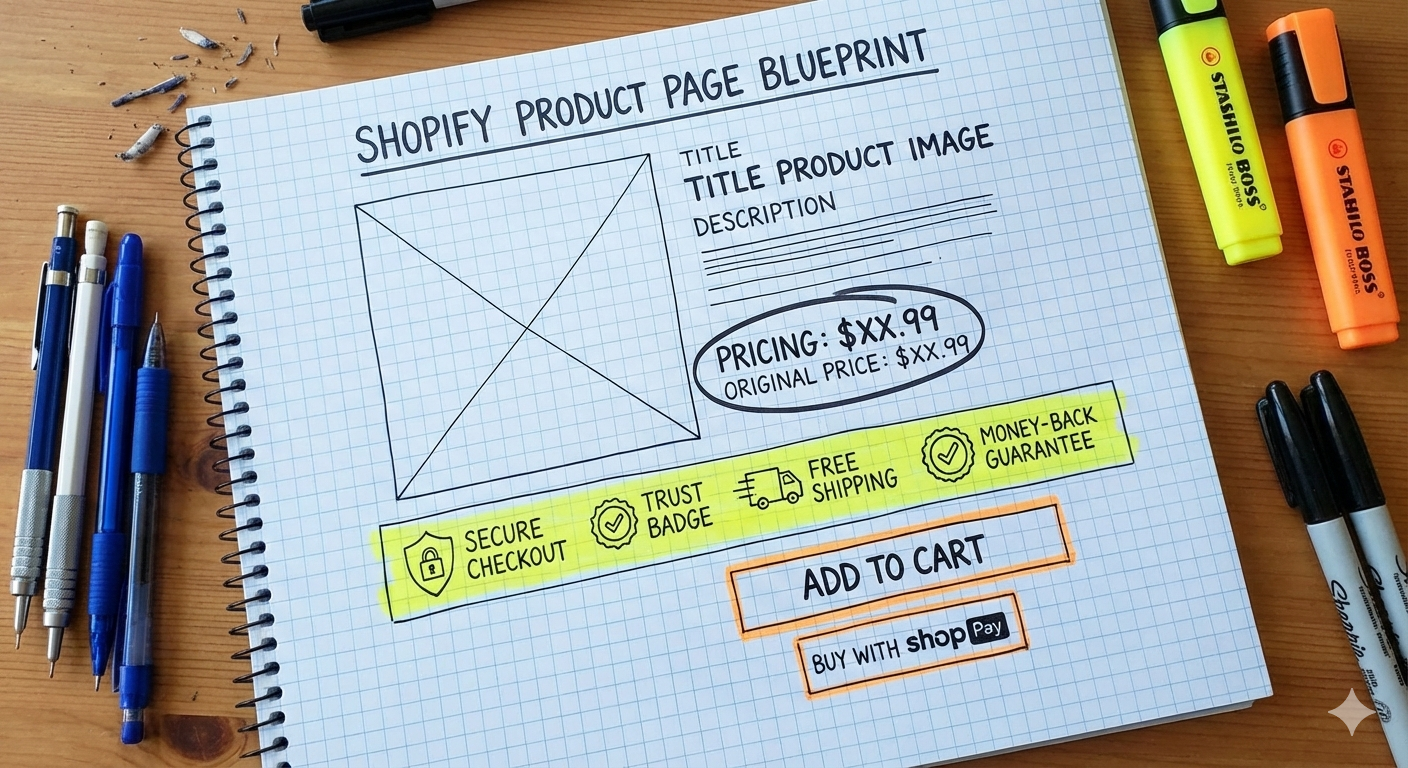
    Shopify product pages play a bigger role in conversions than most store owners realise. You can have strong ads and steady traffic, but if your product pages don’t clearly communicate value, build trust, and guide action, sales will stall. This article breaks down why most Shopify product pages aren’t converting — and what needs to change.

    A product page has one job: turn interest into confidence, then confidence into action.

    If it fails at any step, visitors hesitate, scroll, and leave.

    Let’s break down why most Shopify product pages underperform, and what they’re missing.


    1. Your Product Page Explains What It Is, Not Why It Matters

    Many product pages read like a spec sheet.

    Materials. Dimensions. Features. Bullet points.

    Useful? Yes.
    Persuasive? Not enough.

    Shoppers don’t buy features. They buy outcomes. They want to know:

    • How does this improve my life?
    • What problem does this solve for me?
    • Why is this better than the alternatives?

    If your product description doesn’t quickly answer “why should I care?”, you’ve already lost attention.

    Related read: Why Most Shopify Stores Don’t Convert (And It’s Not Your Ads)


    2. Unclear Value Propositions on Shopify Product Pages

    When someone lands on your product page, clarity must come first.

    However, many pages hide the value behind:

    • long paragraphs
    • generic headlines
    • marketing fluff that says everything and nothing

    Visitors should immediately understand:

    • who the product is for
    • what makes it different
    • why it’s worth the price

    If they need to scroll to figure that out, friction creeps in.


    3. You’re Not Building Enough Trust

    Online shopping is built on trust, especially for lesser-known brands.

    Yet many product pages lack:

    • social proof (reviews, testimonials, UGC)
    • clear shipping and returns information
    • reassurance around quality and support

    Without trust signals, hesitation grows.
    And hesitation kills conversions quietly.

    Even a great product won’t sell if buyers feel uncertain about delivery, returns, or legitimacy.


    4. Your Mobile Experience Is Working Against You

    Most Shopify traffic is mobile.
    Many product pages are still designed desktop-first.

    Common mobile issues include:

    • oversized images pushing key info too far down
    • long blocks of text that feel exhausting to read
    • add-to-cart buttons that disappear while scrolling

    If your product page is frustrating on a phone, users won’t “power through.”
    They’ll exit.


    5. Poor CTA Timing on Shopify Product Pages

    Timing matters.

    Some product pages push “Add to Cart” before trust and value are established.
    Others bury the CTA after endless content.

    A strong product page guides users:

    • first with clarity
    • then with reassurance
    • finally with a confident, visible call to action

    Conversion is a sequence, not a single button.


    The Real Fix: Treat Product Pages as Sales Pages

    Your product page isn’t a catalog entry.
    It’s a salesperson that works 24/7.

    When it explains clearly, builds trust, and removes friction, ads suddenly “work better” — without changing the ads.

    That’s not magic.
    That’s fundamentals.


    Need a Shopify developer or specialist to audit and improve your product pages? Reach out and let’s see how we can improve your store.

  • The Top 5 Things You Need to Know to Be a Shopify Expert

    The Top 5 Things You Need to Know to Be a Shopify Expert

    Becoming a Shopify expert isn’t just about knowing how to use the platform. It’s about understanding how ecommerce works, how merchants think, and how to build solutions that actually move a business forward. Whether you’re a developer, freelancer, or aspiring consultant, these five fundamentals form the core of true Shopify expertise.

    1. Master the Shopify Ecosystem

    Shopify isn’t a single tool—it’s an ecosystem.

    Themes, apps, APIs, checkout, Markets, POS, admin workflows, metafields, and integrations all work together. An expert understands how these pieces connect and where each one fits into a merchant’s operations.

    Knowing the platform’s limitations is just as important as knowing its capabilities. Shopify is powerful, but not magic—and the best experts guide merchants toward realistic solutions.

    2. Understand Liquid, JavaScript, and Theme Architecture

    Every real Shopify customisation revolves around Liquid (Shopify’s templating language), solid frontend skills, and an understanding of Online Store 2.0. Experts know:

    • how Shopify renders data
    • where to place logic
    • how to avoid code bloat
    • how to maintain fast-loading, stable themes
    • how to write clean, scalable section and block code

    If you can build or modify a theme without relying on heavy apps, you’re already ahead of most developers on the market.


    3. Learn How Shopify Businesses Operate

    A Shopify expert isn’t just technical—they’re business-aware.
    You need to understand:

    • conversion paths
    • customer funnels
    • product merchandising
    • fulfillment workflows
    • payment behavior
    • store analytics

    Merchants value experts who solve real problems, not just technical ones. If you can connect your development work to revenue, efficiency, or customer experience, you become indispensable.

    Shopify often requires a mix of:

    • UX/UI knowledge
    • Design sense
    • CRO expertise
    • API integrations
    • Store operations understanding

    4. Know When to Use Apps and When to Custom Build

    Apps are part of Shopify’s DNA, but relying on them for everything leads to bloated, slow stores. A true expert knows:

    • which apps are reliable
    • when to replace an app with custom code
    • how to integrate apps without breaking theme performance
    • how to evaluate app permissions and security

    The goal is to create a balance—flexibility without compromising speed, privacy, or maintainability.

    Split-screen comparison of custom code vs Shopify apps, modern vector design, clean icons, simple and professional.

    5. Stay Updated—Shopify Changes Fast

    Shopify evolves at a relentless pace. New APIs, checkout rules, theme requirements, admin features, and performance guidelines roll out constantly. Experts stay ahead by keeping up with:

    • Shopify changelogs
    • Unite/EDITION announcements
    • API deprecations
    • theme updates
    • new best practices

    Outdated knowledge leads to fragile builds. Updated knowledge leads to future-proof solutions.


    Final Thoughts

    Becoming a Shopify expert isn’t about memorizing features—it’s about understanding how to use the platform to support business growth. Master the ecosystem, learn the tech, understand merchants, make smart build decisions, and keep yourself updated. That combination is what sets real experts apart.